


roberto bellucciqua.
roberto bellucci
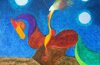
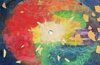
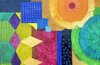
Color is a means of representing a reality that is not seen but which is present in everyday life through sensations,emotions, impressions, moods.
From the basic colors an infinite quantity of chromatic combinations develop which in turn stimulate an equally varied composition of sensations which, if experienced intensely, can involve all the perceptive senses of the human being.

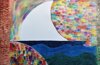
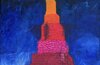
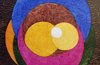
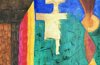
The paintings are made up of a figurative cue, as a gateway to the picture, and a chromatic development, as a sensorial path to tell stories made of sensations.
As the eye detects details and perceives color combinations, the sensations become deeper and more complex.
The work is conceived by living individual or collective experiences.
These sensations lurk in the mind where an image made of figures and colors begins to take shape.
The image has an evolutionary path that can last a few days or years.
Finally comes the realization performed in a single gesture, which seals the apex of the psychic elaboration of the image.
These paintings therefore represent glimpses of the artist's lived sensations and of the people who interacted with them

Select to enlarge





MY STORY
Roberto Bellucci was born in Rome on April 2, 1959, at the age of five his family moved to Africa Somalia in the city of Mogadishu. Today he lives in Naples after having worked in the field of civil aviation.
Since he was a child he loved to paint and play with colors, drawing emotions from them. A period of study and emulation followed that did not satisfy him. He was in search of his artistic identity. This creativity manifested itself at a young age to the point that his parents proposed artistic study paths but he refused to enter a pre-established educational circuit, too limiting and oppressive "he wants to be an artist and not a craftsman". This is how he studied as an Aeronautical Constructor and graduated in Engineering, a profession that allowed him to live a parallel Art/Work until retirement. In 1978 his personal and solitary artistic path began, a search that has never stopped until today. He begins by giving life to imaginative graphics by giving them color, color that from this moment on will always be oil on canvas. This is the beginning of his research.
Anni has gradually abandoned the strong graphic component for a more intense chromatic dominance.
White is always present and represents a fundamental reference in the painting. White is the set of all colors and therefore represents the absolute, where everything originates.
The 90s are characterized first by the search for fluid shapes and colors, moving on to larger dimensions of the works to seek wider spaces of expression. During these years the need to create new chromatic developments is highlighted.
Thus, towards the end of the 90s the absolute novelty of chromatic fragmentation takes shape. An absolutely unique technique where the oil color is worked by subtraction obtaining, in its fragmentation, singular and unique effects of brightness. A brightness that comes directly from the canvas. An elaborate work of management of reflected light that comes close to the idea of generating light.
The 2000s marked the beginning of a more adventurous research in the communicative message, addressing current affairs, politics, and philosophy in an intellectual search for human thought.
This is not enough and since the early 2010s he has begun to accompany his works with comments, thoughts, and reflections.
From Silvia Landi's book: "Defining the intellectual painting of emotions is a necessity for Bellucci, to simplify in three words the greatness of his work that over the years has allowed him to conquer an important space in the history of art. Bellucci has reinvented art with his colors. An unmistakable style for the technique that combined with a fervent imagination allows him to describe what surrounds him, live in the contemporary art market, and exhibit in the most important museums."
say about me
Roberto Bellucci's Art as a Translation of Thought
by Maurizio Di Leo
In the full sense of art as a distinctive element of the human race, Roberto Bellucci expresses the individuality of existence through color, which becomes the primary distinguishing feature of his work.
His color palette is contextualized in his choice of bright and vivid hues, a symptom of his research in African lands, where he had already lived for five years of his childhood (between the ages of five and ten). In an online biography, available on the website artebellucciroberto.com, he recounts his return to Italy, to the Neapolitan capital, where he spent his adolescence somewhat removed from the Neapolitan cultural context: he speaks of a lack of understanding of the language, but of plenty of sun and light, likely the source of his color and a visible point of contact between his African and Italian experiences.
White as an absolute
by Celeste Annunziata
Bellucci not only creates art but also embodies a WELTAN SCHAUNG (worldview), thus becoming a witness.
In the exhibitions and events in which she participates, she creates a virtuous circle around herself; but as Paul Ricoeur would say, "What I am is incommensurable with what I know."
Therefore, there is a constant search for new horizons, an ever-evolving ascent, and the goal shifts ever further.
Fichte's idealism, which points to community as the foundation, is an infinity that is always far from being reached, just as in Bellucci, the search never stops.
Alienation reveals the Marxist rots that lead to sharing the fate of those who suffer injustice. In a universal vision,
The use of white, which represents the union of all colors and therefore the absolute: Where everything originates, often appears in her paintings.
In the beginning, there was everything undifferentiated. Religion or myth preceded the emergence of philosophy, therefore, the boundary was initially blurred.
The first fragment recalls a saying of Anaximander at the origins of Western philosophy, late 7th-early 6th century BC. The first philosophical text, the principle of being, is the infinite. In Greek, a' peiron /unlimited, indeterminate. From where, in fact, beings originate, there they also experience destruction according to necessity:
since they pay to one another the penalty and atonement for injustice, according to the order of time." Fragment 12 D. K. B1
And everything is a blank slate. At a certain point, men and things appear. History (time) begins. How? By an Injustice that shatters like lightning what was initially united and ordered. Therefore, punishments and atonements, that is, wars, destructions, and sufferings, are necessary to return to the harmonious whole. Leopardi in the Infinite says, "It is sweet to be shipwrecked in this sea."
Nirvana is the return to the undifferentiated whole where there are no longer individuals but also the original sin of Cain and Abel.
In short, in many cultures, harmony is broken by an injustice, and Anaximander has it. Said in the 7th century BC, already using philosophical logical categories. And Bellucci, in his use of white, recalls all of this, in my opinion.
Prof. Celeste Annunziata

GALLERY


CONTACTS
TELEPHONE: +39 3381374069
e-mail: bellucci.roberto@alice.it